Few cuts flatter as many faces as the A-line bob. Shorter at the back and gradually longer towards the front, it draws a clean diagonal line that slims the face, shows off the jawline and adds instant polish — without the upkeep of a fussy layered cut. It works straight, wavy or curly, short or lob-length, and it has stayed in demand for decades for one simple reason: the angle does the styling work for you. Here is what it is, who it suits best, and how to wear it well.
What Is an A-Line Bob Haircut?

An A-line bob is a bob cut on a forward angle: the hair is shortest at the nape of the neck and gets gradually longer towards the front, so the silhouette resembles the shape of the letter A. The perimeter is usually blunt and precise, which keeps the line clean and makes even fine hair look fuller. Unlike a graduated or stacked bob, which builds stacked layers at the back for volume, the A-line relies on geometry rather than layering — a smooth, continuous slope with little internal bulk. The front can end anywhere from the chin to the shoulders, so the same idea works as a short, sharp bob or a longer lob-length version.
A-Line Bob vs Classic Bob

The difference is all in the outline. A classic bob is cut to one even length all the way around, while an A-line bob slopes forward. That single change alters the whole effect:
| Feature | Classic bob | A-line bob |
|---|---|---|
| Length | Even all around | Shorter back, longer front |
| Shape | Horizontal line | Diagonal, forward angle |
| Face effect | Soft, balanced | Slimming, elongating |
| Best for | Easy grow-out, low drama | Definition, face-framing |
Choose the classic bob if you want softness and the simplest grow-out. Choose the A-line if you want your cut to do more — to sharpen the jawline, lengthen the neck and give fine hair a fuller-looking front.
Is an Angled Bob the Same Thing?
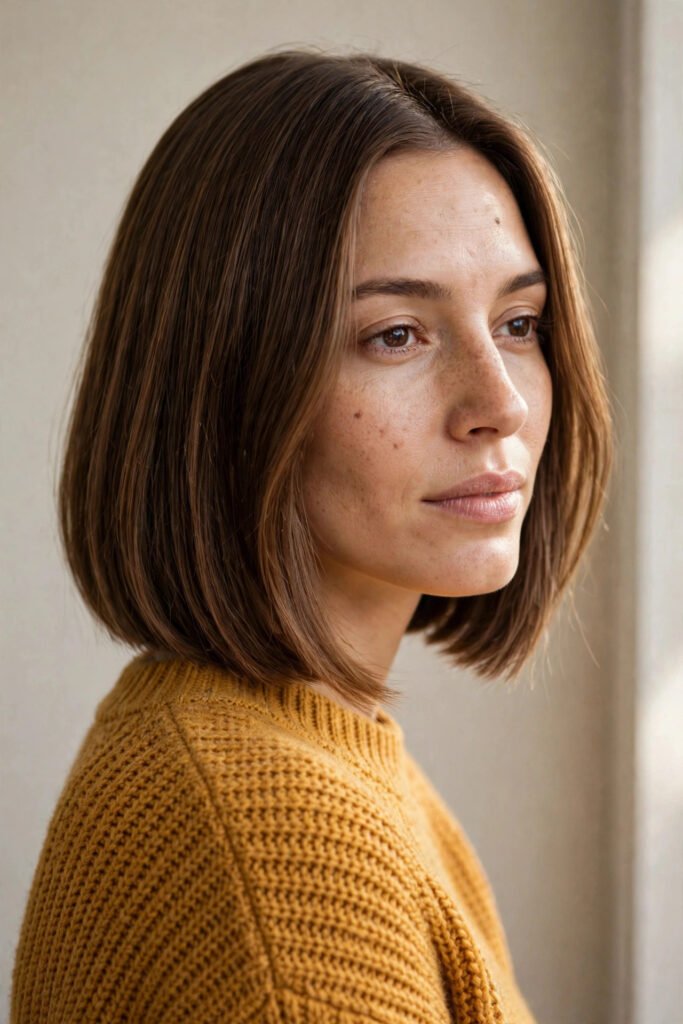
Yes — “angled bob” is simply another name for the A-line bob, and salons use the two terms interchangeably. Both describe the same shorter-back, longer-front cut. The confusion comes from related names: an inverted bob is similar but has stacked, graduated layers at the back, while a concave bob is another name for the same angled shape. When booking, do not rely on the label alone — show a photo and say how much shorter you want the back to be than the front. That one measurement, more than any name, decides how your cut will actually look.
Subtle vs Dramatic A-Line Angles

The angle is adjustable, and it changes the personality of the cut completely. A subtle angle — the back only a centimetre or two shorter than the front — reads as a polished, office-friendly bob with just a hint of shape. It is the safest first step and the easiest to grow out. A dramatic angle — the back cropped near the nape while the front falls to the chin or below — is bold, graphic and unmistakably modern. It suits straight hair best, because smooth hair shows the line most clearly, while very curly hair needs a stronger angle before the slope is visible at all. Start subtle if you are unsure; a stylist can always steepen the angle later.
A-Line Bob with Bangs

Bangs pair beautifully with an A-line bob, because the fringe adds a second frame around the face. A side-swept fringe is the most versatile choice: it blends into the longer front sections and grows out without an awkward stage. Curtain bangs soften the geometry and suit anyone who finds a blunt perimeter too severe, while a straight-across fringe gives the most striking, graphic result — the full “A” shape, echoed at the forehead. One caution: a heavy blunt fringe plus a very dramatic angle can feel like a lot of geometry at once, so if you go bold on one, keep the other softer.
Which Face Shapes Suit an A-Line Bob?

The A-line is one of the most forgiving bob shapes, because the longer front pieces do the flattering work:
- Round faces: the diagonal line and longer front sections elongate the face — the strongest match of all.
- Square faces: the forward angle softens a strong jaw, especially with a side part.
- Oval faces: almost every version works; choose the angle by personality, not by rules.
- Heart-shaped faces: longer front pieces balance a wider forehead and narrower chin.
- Long faces: keep the front at chin length and add a fringe or waves for width.
Because the angle can be tuned, a good stylist can adapt this cut to nearly any face — the front length is the lever that matters most.
A-Line Bob for Different Hair Types

Fine hair: this is where the A-line truly shines. The blunt perimeter makes ends look thicker, and pushing length towards the face creates the illusion of fullness at the front, where fine hair often looks thinnest. Keep layers minimal. Thick hair: ask for light internal texture so the angle does not turn into a heavy triangle — the shape stays, the bulk goes. Wavy hair: the angle gives waves direction instead of letting them fall flat; scrunch in light cream and air-dry. Curly hair: keep extra length at the front, since curls spring up when dry, and have the angle cut with your curl pattern in mind rather than pulled straight.
How to Style an A-Line Bob at Home

The A-line is a genuinely low-effort cut — ten minutes is plenty:
- Prep damp hair with heat protectant and a light volumising mousse at the roots.
- Rough-dry to about 80%, directing hair forward so the angle falls naturally.
- Smooth with a paddle brush for a sleek finish, or a round brush to curve the front pieces under.
- Flat-iron the front sections only if needed — they carry the whole look.
- Finish with a drop of smoothing serum on the ends for shine and definition.
For a softer, lived-in version, skip the brushes: add texturising spray, air-dry, and tuck the shorter side behind one ear.
A-Line Bob Maintenance and Grow-Out

Plan a trim every 6 to 8 weeks. The angle is the whole point of the cut, so once the back catches up with the front, the shape quietly becomes a classic bob — still a good haircut, but no longer an A-line. Between appointments, protect the longer front sections, which take the most heat styling, with a weekly mask. The grow-out is forgiving: as the angle softens, the cut passes through a classic bob and then a lob, and a few long layers along the way keep every stage wearable. If you love the angle, book the trim before it disappears rather than after.
What to Ask Your Stylist for an A-Line Bob

Bring reference photos, and be specific about the two lengths that matter: where the back should end, and where the front should end. Say: “an A-line bob, shorter at the nape and longer at the front, ending at [my chin / just below my chin] in front, with a [subtle / dramatic] angle and [a side part / side-swept fringe].” Ask how the angle will be adjusted for your face shape and hair texture, and how it will look as it grows out. If you are nervous about the angle, start subtle — it can always be steepened at your next appointment, but length cannot be put back.
A-Line Bob Haircut FAQs
Is an A-line bob the same as an angled bob?
Yes. The two names describe the same shorter-back, longer-front cut. Salons use them interchangeably.
Does an A-line bob suit round faces?
Beautifully. The longer front sections and diagonal line elongate a round face, especially with a side part.
Is an A-line bob good for fine hair?
It is one of the best bob choices for fine hair. The blunt ends look thicker, and the forward angle creates fullness at the front.
How often should I trim an A-line bob?
Every 6 to 8 weeks. Without trims, the back catches up with the front and the angle — the whole point of the cut — disappears.
Can I wear an A-line bob with curly hair?
Yes, but keep extra length in the front because curls spring shorter when dry, and have the angle cut to your natural curl pattern.
Written by the New Light team. Fancy trying one of these shapes? Send us a message and bring your favourite photograph when you visit.